Sand and clay-limestone: two soils, two wines
Winemaker · 11 November 2026
- In Janas our vines grow in clay over limestone. In Colares, in deep sand by the sea. Here is what changes in the vineyard and in the glass.
Between the Sintra hills and the Atlantic, Quinta de San Michel farms 7.2 hectares of vines on two very different grounds. In Janas, the vines grow in clay over limestone, on south-facing slopes. In Colares, by the sea, they grow in deep sand, as they have for centuries. The grape may be the same; the wine is not.
Three layers of history
To understand these soils, you have to look down. The geology here comes in three layers. At the base lie Jurassic marine limestones, formed on the floor of an ancient sea. Above them sits the Sintra igneous complex, which raised the hills. On top are Quaternary dune sands, carried in by the sea and the wind.
In Janas, the vines root in clay and limestone. In Colares, the roots first cross the sand before they reach that same limestone.
Janas: clay over limestone
Our Janas vineyard sits at about 200 metres, on gentle south-facing slopes. The soil is calcareous clay, medium to medium-deep, over Jurassic limestone bedrock. The clay holds water and nutrients through the summer; the limestone gives the wine tension and freshness.
This is where it all began, in 2013. Today the Janas vines are between 6 and 13 years old. They are grafted clones on SO4 rootstock, planted at about 5,000 vines per hectare.
| Plot | Area | Planted | Wines |
|---|---|---|---|
| Malvasia de Colares and Arinto | 1 ha | 2013 | Malvarinto de Janas, Curtimenta |
| Malvasia de Colares | 0.6 ha | 2015 | Malvasia |
| Arinto | 0.4 ha | 2015 | Arinto |
| Galego Dourado | 0.3 ha | 2020 | Galego Dourado |
| Arinto, Zé Moço plot | — | 2020 | A Névoa de Janas (exceptional years only) |
Colares: the sand
In Colares, the vines grow in the famous chão de areia, the sandy ground. On the valley floor, the sand is siliceous and several metres deep, over calcareous clay and limestone. On the bluffs, higher up and facing the sea, the sand is calcareous and sits right on the bedrock. It is a poor soil, almost without organic matter, that holds no water.
The sand holds an old secret: phylloxera, the pest that destroyed Europe’s vineyards in the 19th century, cannot survive in it. That is why Colares is one of the few places in the world where vines have always been planted on their own roots. Our sand vines are the same: own-rooted massal selections, planted at about 3,000 vines per hectare.
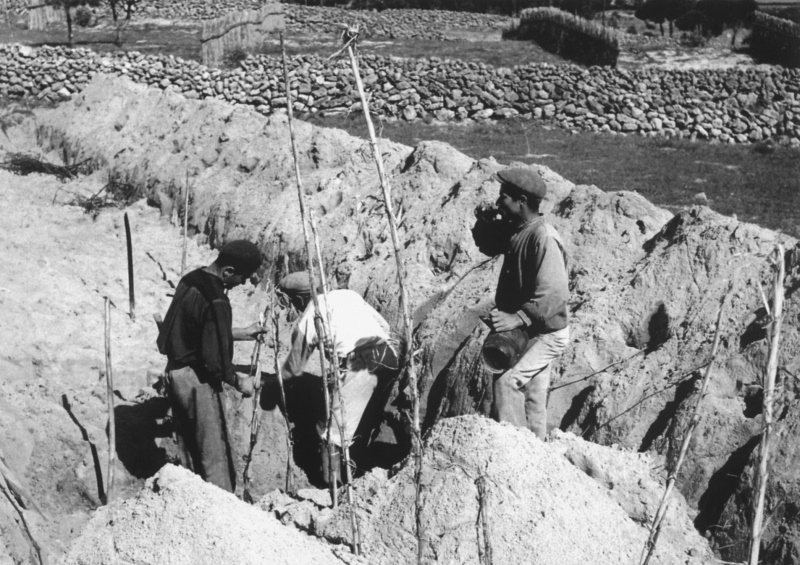
We planted our first sand vineyards in 2023, in the Borneirinhos, Mar da Aguda and Ribeirinha plots. The grapes are those of Colares: Malvasia de Colares, Ramisco and a small share of Arinto. Traditionally, growers dug trenches through the sand down to the clay and planted there. We planted long canes straight into the sand, and the roots themselves go down in search of water and limestone.
The vines grow low, almost lying on the sand, to shelter from the salty Atlantic wind. They are still very young: three years old.
The climate: Atlantic and hills
Both vineyards share the same climate. The ocean and the Sintra hills bring humidity and fog and hold temperatures steady: in summer, days reach 25 to 26 °C and nights 16 to 17 °C. Frost is rare and hail uncommon.
This freshness gives wines with natural acidity and moderate alcohol. It also demands care: mildew and rot are the big challenges. Harvest, still in October in 2017, has moved to early September in recent years.
How we farm
We farm with organic practices, without certification. We plough once a year, after harvest, and sow cover crops of lupin, vetch and berseem clover. We feed the vines with horse and sheep manure.
We use less than 2 kg of copper per hectare a year, with silica and seaweed extracts. In 2025 we cut mildew treatments from 10 to 6. Japanese beetles are trapped and snails picked by hand.
In the cellar
The grapes are whole-cluster pressed and ferment with native yeasts. Every wine goes through malolactic fermentation, ages on its lees and is bottled with a light filtration, never fined. No lab makes the decisions: tasting does.
In the glass
The Janas whites have more body, structure and texture. Served cold, some compare them to a classic, muscular Meursault; a little warmer, they show grape and place more clearly. Arinto is straight and structured, Malvasia brings charm and layers, and Galego Dourado moves from reductive notes to spice.
The sand wines are finer and more delicate, with lively acidity, lower alcohol and a saltiness that recalls the sea next door. Ramisco, the only red grape of the Colares region, has high acidity, firm tannins and around 11 to 12% alcohol. It needs years in bottle.
In sand, Malvasia is lifted and fine. In clay, it is more powerful and muscular.
Side by side
| Janas | Colares | |
|---|---|---|
| Soil | Calcareous clay over Jurassic limestone | Deep siliceous sand over calcareous clay; calcareous sand on the bluffs |
| Where | Gentle south-facing slopes, about 200 m | Valley floor and bluffs above the Atlantic |
| Planted since | 2013 (vines 6 to 13 years old) | 2023 (vines 3 years old) |
| Vines | Grafted clones on SO4, about 5,000 vines/ha | Own-rooted, massal selection, about 3,000 vines/ha |
| Grapes | Malvasia de Colares, Arinto, Galego Dourado | Malvasia de Colares, Ramisco, a little Arinto |
| Style | Body, structure and texture | Finesse, lively acidity and salinity |
| Wines | Malvarinto de Janas, Malvasia, Arinto, Galego Dourado, Curtimenta, A Névoa de Janas | Ramisco sparkling base (2025); first white and first red Ramisco (2026) |
Two soils, one Quinta
In 2025 we picked our first Ramisco from the sand, at Ribeirinha, as the base for a special sparkling wine. In 2026, our 10th harvest, came the first white, from Borneirinhos, and the first red Ramisco. They will be the Quinta’s first Colares DOC wines, and they are still ageing in the cellar.
Having both soils lets us show two sides of Malvasia de Colares, and of Sintra. Want to taste the difference? Come and taste the Janas wines at the Quinta, with the hills ahead and the sea behind.
