Malvasia de Colares is a white grape native to Colares, a tiny wine region near Sintra, squeezed between the hills and the Atlantic Ocean. Despite the name, it is not just another Malvasia: it is a variety of its own, born on this stretch of coast, and the main grape of Colares DOC white wines. It makes wines with high acidity, moderate alcohol and a saline edge that tastes of the sea nearby.
The grape that escaped phylloxera
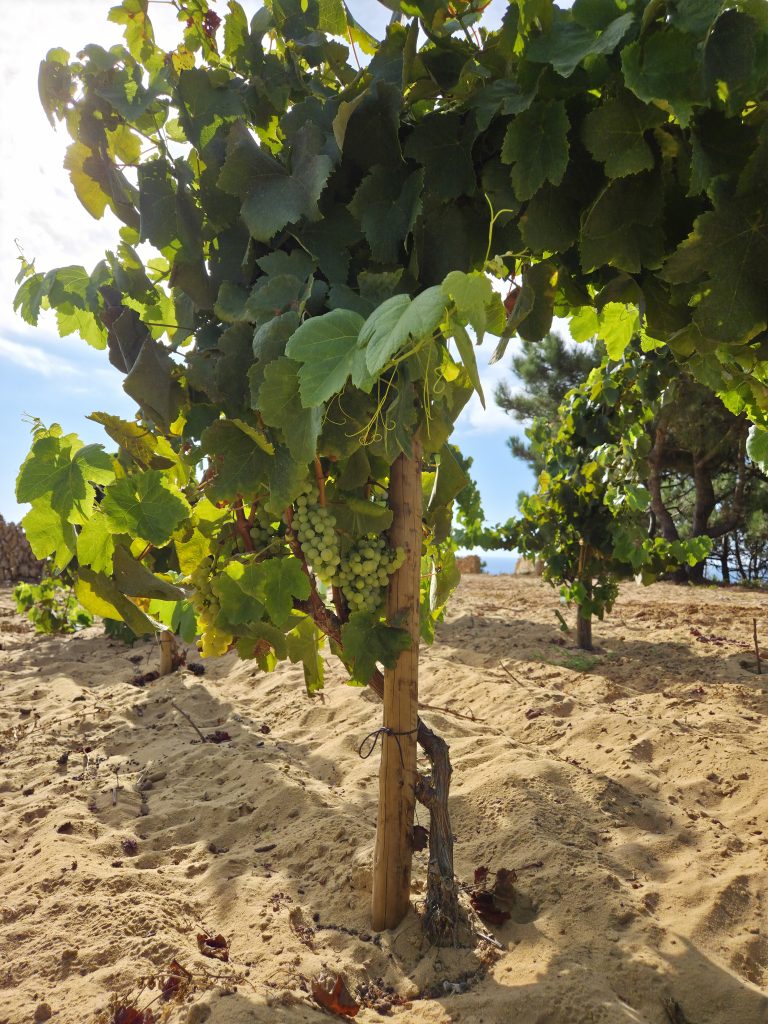
In the second half of the 19th century, phylloxera, a tiny insect that attacks vine roots, wiped out most of Europe’s vineyards. The cure was to replant on American rootstocks resistant to the pest. In Colares, that was never needed: vines planted in the dunes survived, because phylloxera cannot travel through loose sand.
That is why many Colares vines still grow ungrafted, on their own roots, like European vines before the plague. They are among the very few left in Europe.
Planting in sand, known locally as chão de areia, is hard work. Growers dig through one to four metres of sand to reach the clay and limestone beneath, where the roots take hold. The vines grow low along the ground, sheltered from the Atlantic wind by fences made of cane. Further inland, Colares also has chão rijo, firm clay and limestone soils.
Colares has been a demarcated wine region since 1908, one of the oldest in Portugal, and has two signature grapes: Malvasia de Colares for whites and Ramisco for reds. At its peak it had over a thousand hectares of vines. Today around 20 remain, hemmed in between the hills, the sea and the houses.
The grape itself belongs to this land. Local producers describe it as a crossing born in Colares, and genetic studies point to Hebén and Amaral as its parents.
What Malvasia de Colares tastes like
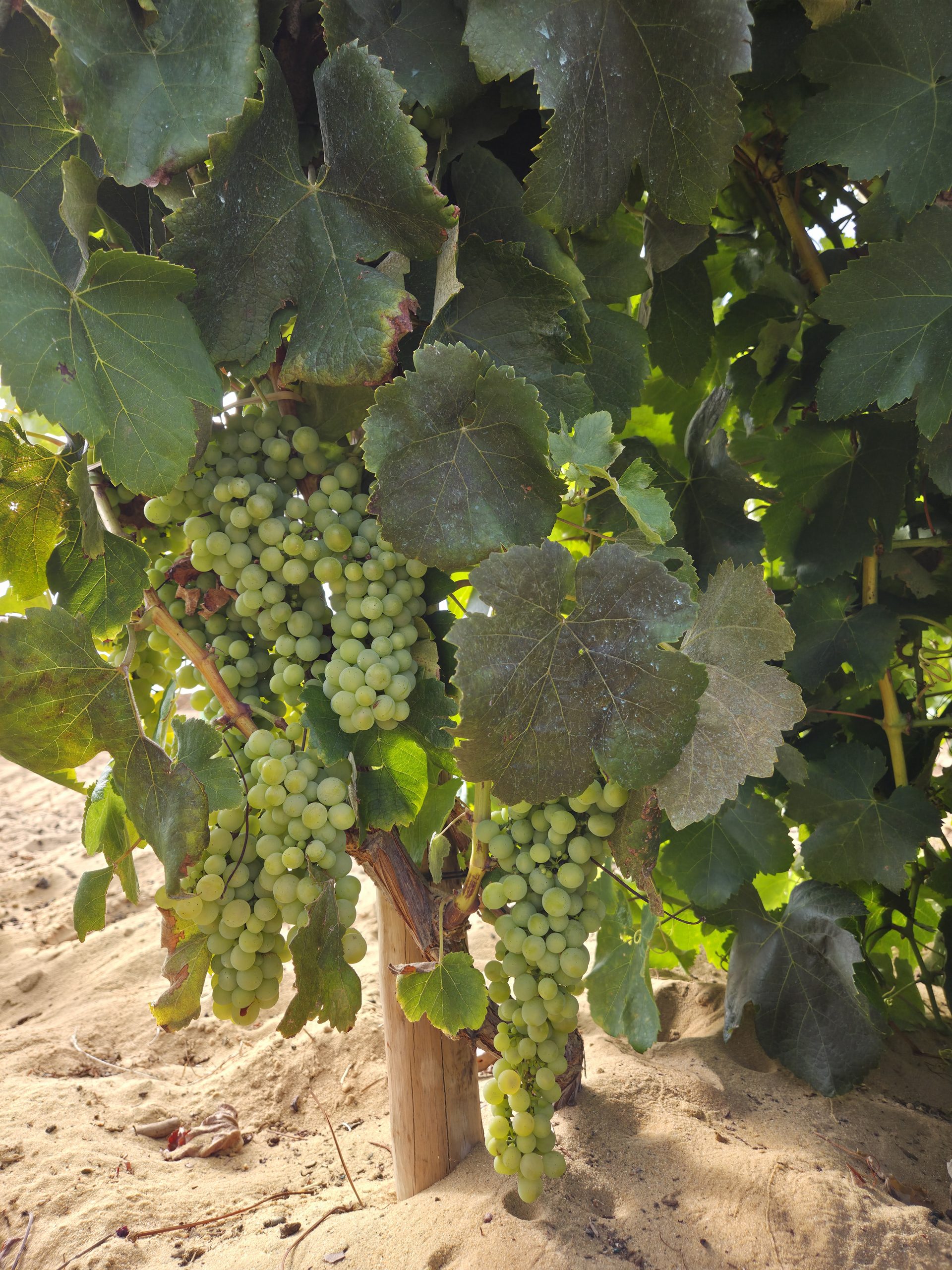
Malvasia de Colares makes wines with high acidity and moderate alcohol, yet more body than the alcohol would suggest. Expect citrus and green fruit on the nose; on the palate, a saline, almost sea-spray note and a slightly waxy texture.
The climate explains a lot. The vineyards sit a few kilometres from the Atlantic, with frequent fog and cool summers, so the grapes ripen slowly and keep their freshness.
With time in bottle the wines gain complexity and sometimes develop a light petrol note, typical of great high-acid whites. That acidity is what gives them their ageing potential.
Malvasia de Colares at Quinta de San Michel
At Quinta de San Michel, in the village of Janas, Malvasia de Colares has been at the heart of the project since the first vines were planted in 2013. Today it grows on two different terroirs.
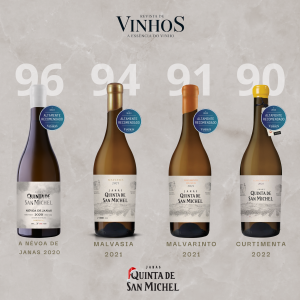
On clay-limestone soils, in the Quinta de San Michel and Zé Moço vineyards, at 170 to 180 metres. These are the vines behind the wines you can taste today:
- Malvasia: 100% Malvasia de Colares, aged 10 months on the lees in French, American and Hungarian oak, then 15 months in bottle.
- Sparkling wine: 100% Malvasia de Colares, aged 24 months on the lees. The grape’s natural acidity makes it ideal for sparkling wine.
- Malvarinto de Janas: a blend of Malvasia de Colares and Arinto, first released in 2017 and one of the estate’s signature wines.
- Curtimenta: Malvasia de Colares and Arinto, fermented for 30 days on the skins.
On sand, in the new Mar da Aguda and Borneirinhos vineyards, planted in 2023. Here Malvasia de Colares returns to the region’s traditional ground; at Mar da Aguda it is bush-trained. They gave their first harvest in 2026, and the estate’s first sand-grown Malvasia de Colares is on its way.
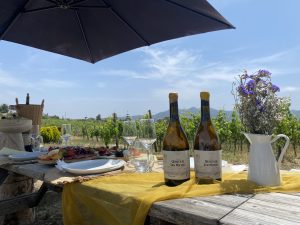
To see both terroirs side by side, the Where the Vine Meets the Atlantic tasting takes you from the estate’s vineyards to the sand vineyards, ending with a tasting of four wines facing the ocean.
Food pairing
Its freshness and salinity make Malvasia de Colares a natural food wine, especially with seafood.
- Malvasia: coastal dishes, from grilled cuttlefish to razor clam rice, and fresh summer salads.
- Sparkling wine: oysters, limpets and shellfish, as well as fresh Asian food.
- Curtimenta: with more structure, it stands up to meat such as roast suckling pig or lamb.
Serve the whites cool but not ice-cold: too much chill hides the grape’s complexity.
Frequently asked questions
Is Malvasia de Colares the same grape as other Malvasias?
No. Many grapes are called Malvasia in Portugal and around the Mediterranean. Malvasia de Colares is a distinct variety, native to the Colares region near Sintra.
Why did the Colares vineyards survive phylloxera?
Because many are planted in sand. The insect that destroyed Europe’s vineyards in the 19th century cannot move through loose sand to reach the roots.
What does “ungrafted” mean?
The vine grows on its own roots, without an American rootstock. Since phylloxera this is rare in Europe, but it still happens in the sand vineyards of Colares.
What does Malvasia de Colares wine taste like?
Fresh, with high acidity, moderate alcohol, citrus aromas and a saline note that recalls the sea.
Where can I taste Malvasia de Colares near Lisbon?
At Quinta de San Michel, in Janas, 40 minutes from Lisbon. Our wine tastings include a tour of the vineyards and winery, by appointment.
Quinta de San Michel · Janas, Sintra · Colares wine region